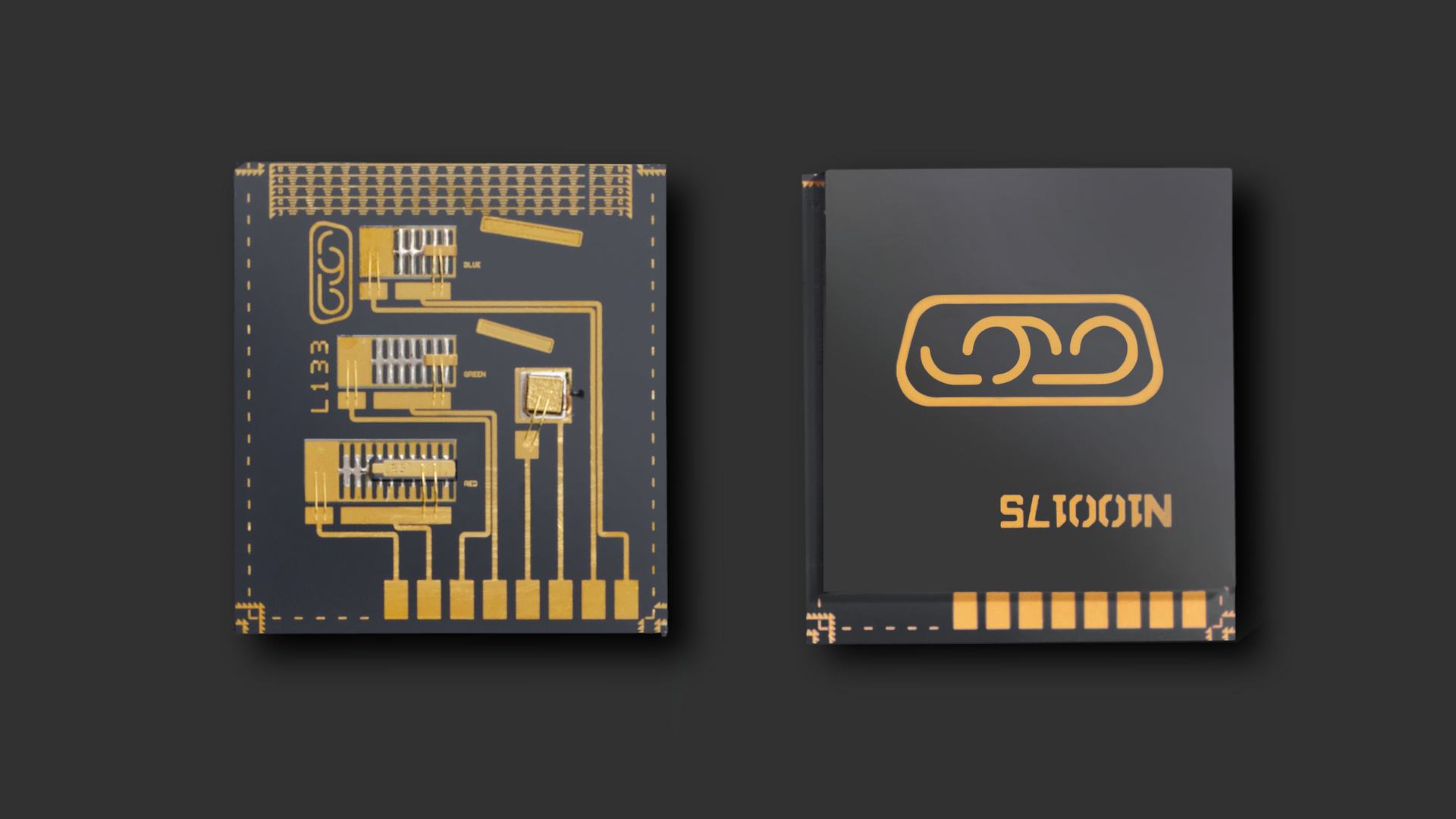
Neptune — the Brilliance miniature RGB laser BRL-02a-P-L — is the smallest light engine to integrate red, green and blue laser diodes for projection applications. It combines photonic integrated circuit technology with laser beam scanning in one component.
What is inside
Neptune is built on TripleX®, a silicon-nitride waveguide platform with high refractive-index contrast and exceptionally low propagation loss — from 0.1 dB/cm down to 0.1 dB/m. Silicon nitride matters here because it transmits across the visible range and handles high optical power, which is exactly what a projection light source needs.
The red, green and blue laser diodes are flip-chip assembled into precisely etched cavities in the substrate, which aligns them passively rather than by hand. A negative temperature coefficient sensor can be integrated the same way for temperature measurement and control.
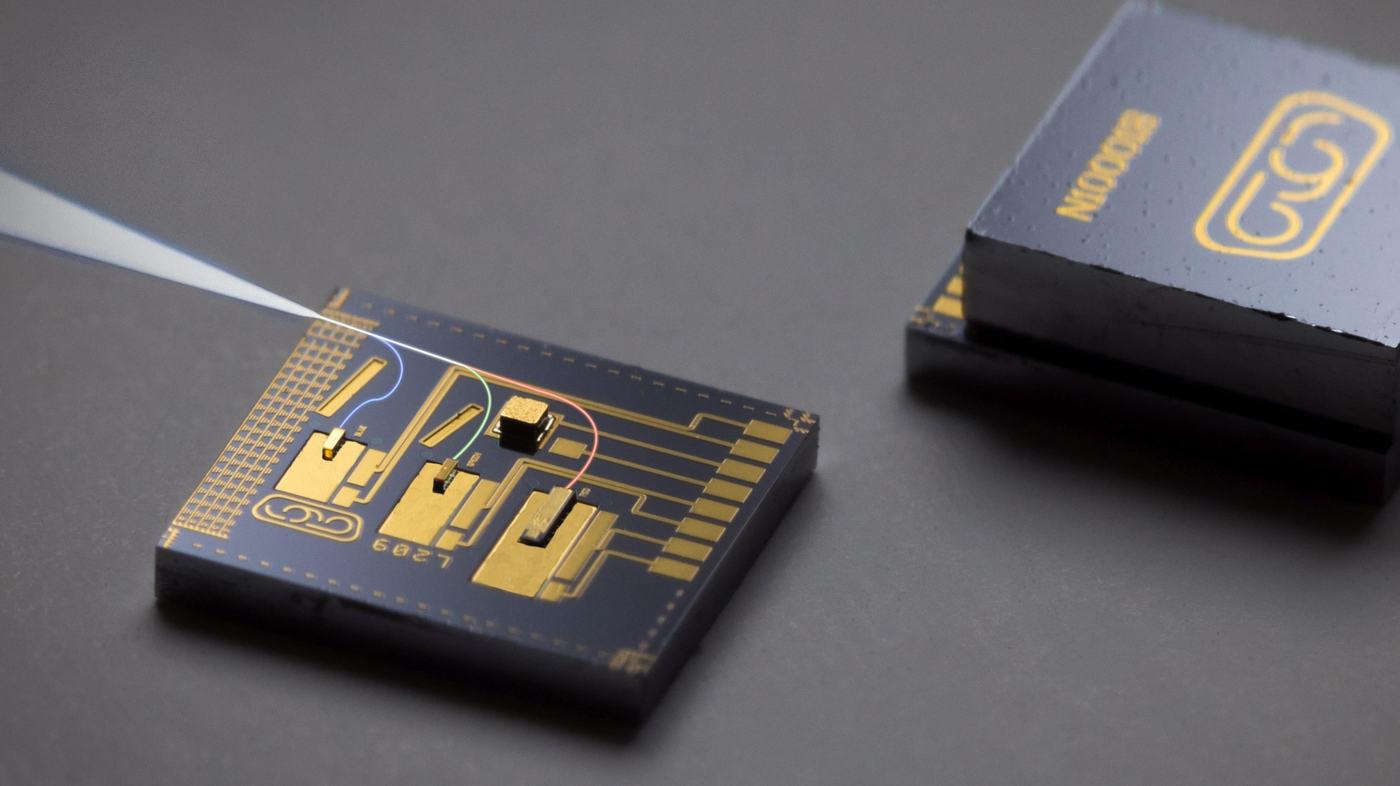
Specifications
Output power reaches up to 100 mW, at 637 nm, 520 nm and 450 nm or custom wavelengths. The chip occupies 5–20 mm² and is 1.5 mm thick. Integrated power monitoring and speckle reduction are available, as are custom designs with additional sensors or an infrared laser for eye tracking. Optical output properties — numerical aperture, circular or elliptical beam, M² — are controllable by design.
What it replaces
Compared with conventional laser beam scanning, LCoS and µLED displays, the integrated approach offers up to ten times better efficiency. It gets there by deleting parts: the discrete sources and the beam-combining optics that make a conventional stack the largest, hottest and most power-hungry component in the system.
We are able to generate a lot of light from a tiny form factor using relatively little power.
Douwe Geuzebroek, CTO, Brilliance
Neptune is the current state of the platform, not its end point — further integration is expected to reduce the size significantly again. The full technical treatment is in the whitepaper, Small and Scalable RGB Laser Engine for Augmented Reality.