
Multi-output configurations and wavelength routing
Integrated wavelength routing enables multiple outputs and flexible optical architectures.
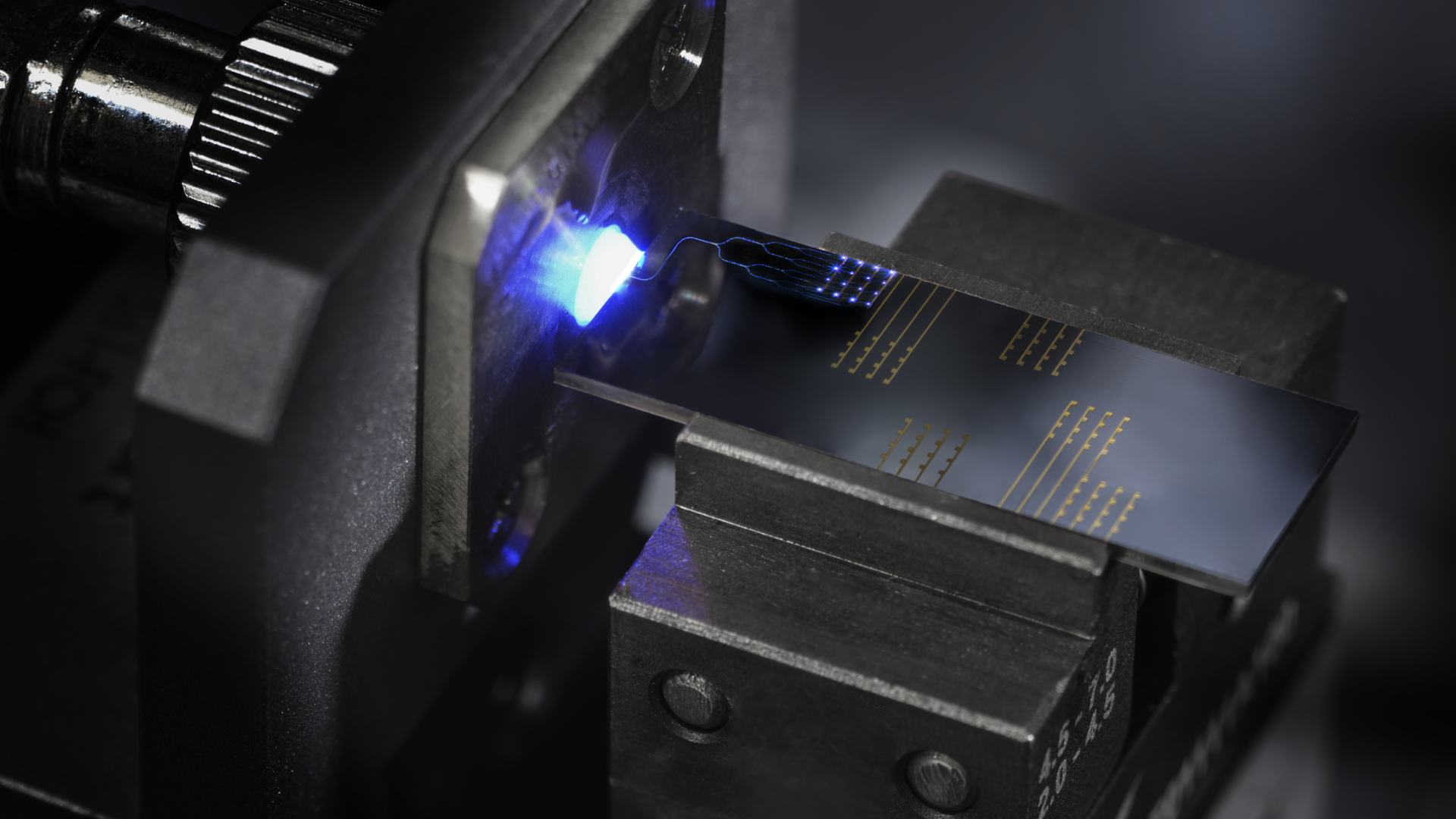
Integrated wavelength routing enables multiple outputs and flexible optical architectures.
Optimized beam shape, divergence, and illumination profile for optimal display performance.
Maximizes optical efficiency by optimizing light extraction and optical coupling.
Integrated optical functions reduce external components, simplifying assembly and minimizing footprint.
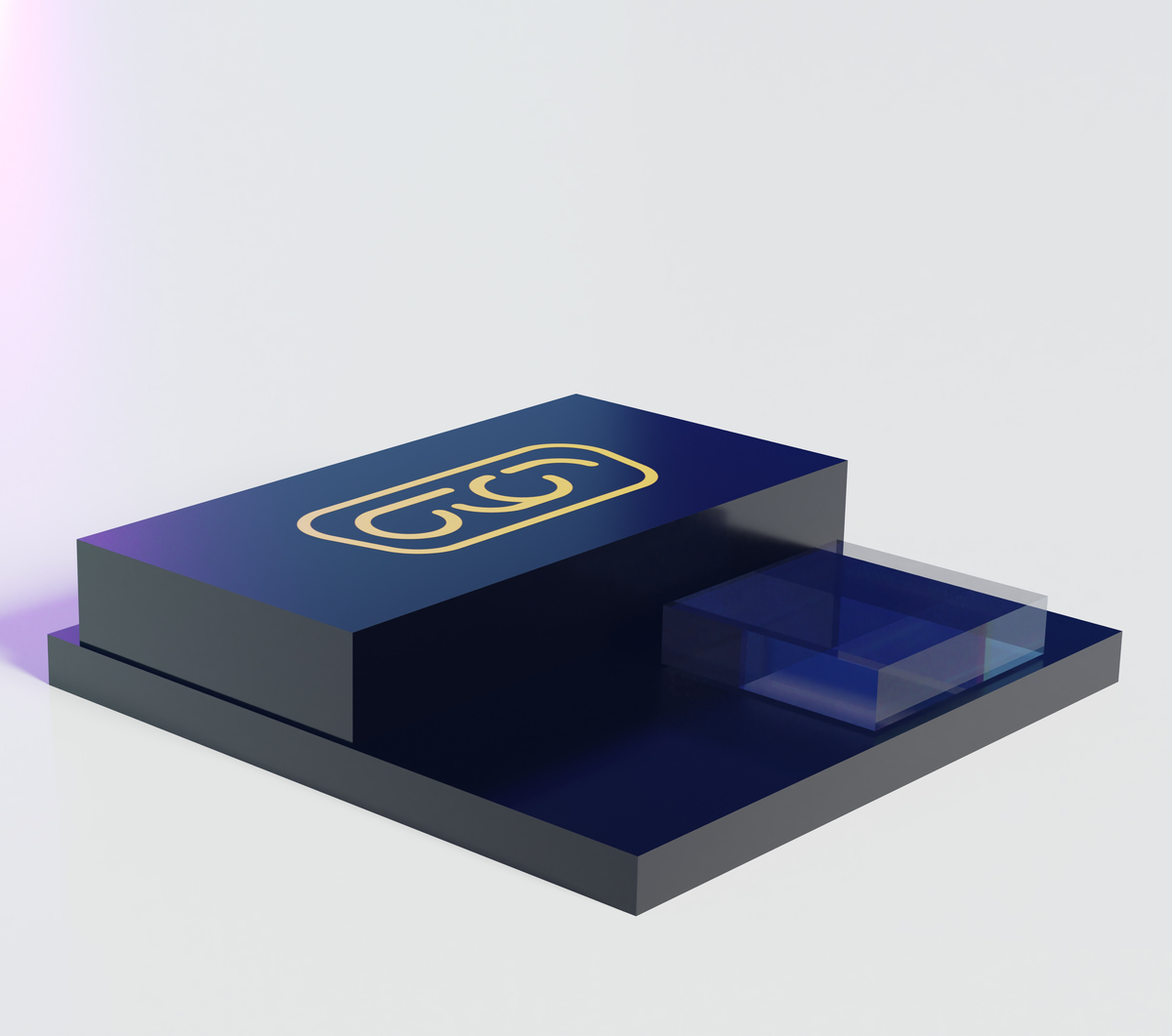
| Lumen Output | 48 lm |
|---|---|
| Typical luminous efficacy D65 white | up to 20 lm/W |
| Wavelengths | 639 / 520 / 450 nm (target) |
| Typical output power | 50-120 mW per channel |
| Uniformity | > 90% |
| Display class | LCoS |
| Availability | Sampling Q4'26 |
For applications requiring uniform wide-field illumination, Brilliance Area Illuminators deliver compact, integrated laserchip solutions for next-generation display systems. The Luna family supports LCOS and other advanced display architectures through customer-tailored solutions.
| Full-field illumination | Uniform, top-hat, rectangular area illumination |
|---|---|
| LCoS-optimised | Matched to micro-display |
| Single-mode wavelengths | RGB 639 / 520 / 450 nm |
| High efficiency | Integrated optics reduce losses |
| Beam collimation and steering | Integrated metasurface |
| Coupling efficiency optimization | Enabled by vertical couplers |
| Multiple output beams | Enabled by RGB splitters |
Every Luna area illuminator is tailored to your optical design, with customized illumination profiles, panel sizes, and output configurations.
Matched to your LCoS panel dimensions
Maximizes light utilization and system brightness
Built for complex architectures
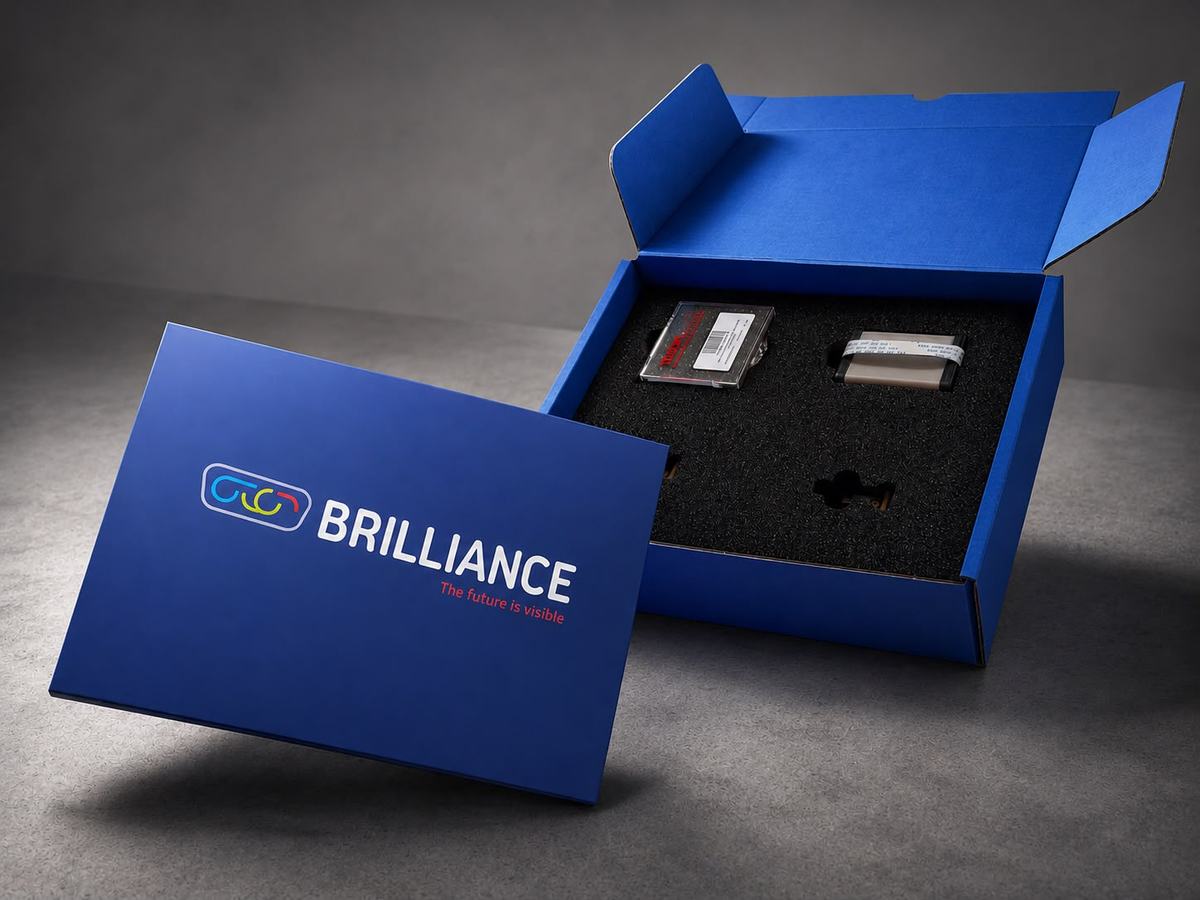
Expected kit contents (provisional):
One integrated photonics platform powers both our point and area illuminators. Explore the technology that makes it possible.
Brilliance coined the term "laserchip" to describe its integrated photonics platform, combining lasers and optical elements into a single chip. Replacing traditional discrete laser systems and optical components such as lenses and prisms, a single laserchip simplifies system design while reducing size, complexity, and cost.
Compared to traditional discrete optical laser systems, laserchips are typically over 10× smaller, more efficient, offer higher and more consistent quality, and can be mass-produced at wafer scale using standard semiconductor processes. They simplify system design, improve robustness, and require no calibration or maintenance over their lifetime.
Integrated Photonics is the technology used to manufacture optical chips. Unlike conventional electronic chips, which operate using electrons, these chips manipulate light (photons) and are known as Photonic Integrated Circuits (PICs). PICs guide and control light on-chip to perform a wide range of optical functions and are already widely used in applications such as high-speed optical data communication in data centers. Manufactured using standard semiconductor processes, PICs not only enable miniaturization and improved performance but also allow optical systems to be mass-produced far more efficiently than traditional discrete optical assemblies.
Brilliance is the 1st company in the world to have realized a fully integrated laser platform in the visible light domain, typically offering Red, Green and Blue (RGB) color lasers combined on a single chip. This opens a broad range of possibilities for projectors, sensing applications, automotive and many other fields.
Integrating all this functionality onto a single chip required overcoming significant technical challenges. Unlike the infrared light used in data communications, visible light requires a fundamentally different chip design, incorporating Brilliance's patented design innovations. Integrating red, green, and blue laser diodes with different wavelengths and performance characteristics was another major challenge, made possible only by recent advances in visible laser technology. By combining these innovations into a single chip, Brilliance enables compact laser-based systems for augmented reality, automotive, and industrial applications.
At the projector level, the main advantages of laser are higher efficiency, brightness, and image quality. Brilliance's Laserchip enables projector footprints below 0.5 cc, previously impossible, making it particularly well suited for Augmented Reality eyewear. It also reduces the weight of the laser light source and combiner from 2-5 g to just 0.05 g (up to 100× lighter), where every gram is critical for all-day wearing comfort.
The Brilliance portfolio supports various projection architectures as developed by our industry partners, such as laser illuminated LCOS, Laser Beam Scanning, Holographic projectors and others.
Brilliance can integrate many functions onto its platform, both in the optical domain (multiple outputs, on-chip combiners, NA tuning, various wavelengths etc) as well as integration of components like photodiodes, switches, laserdrivers and other functions onto our chip. For miniature projectors, for example for AR eyewear, we can help shrink the total system even further by integrating additional functions onto our chip.
It’s actually the opposite: laserchips structurally achieve higher performance than even very expensive traditional discrete laser systems. Thanks to our patented PIC designs, the laser light can be optimally shaped and optimized in a much better way than possible with discrete optics. For example, we can make the laser spot perfectly round, and achieve superior color overlap. This matters a lot for image quality. Not only is the quality of the laser beam on par or better than the most advanced and expensive discrete laser solutions, it will also remain more constant over lifetime and temperature as semiconductor technology is very stable and repeatable.


